The Master of Us All: Balenciaga, His Workrooms, His World by Mary Blume
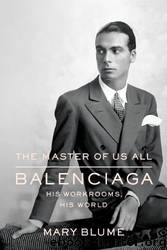
Author:Mary Blume [Blume, Mary]
Language: eng
Format: epub, mobi
Tags: Industries, Artists; Architects; Photographers, Biography & Autobiography, Fashion & Textile Industry, Cultural Heritage, Business & Economics
ISBN: 9780374298739
Google: uyCY6qNXFl0C
Amazon: 0374298734
Publisher: Macmillan
Published: 2013-02-05T00:00:00+00:00
* * *
The carefully choreographed winter and spring collections followed roughly the same order at all the fashion houses, although only at Balenciaga were the ashtrays that viewers dipped their cigarettes in made of heavy marble. Suits and daytime dresses came first, then evening wear of increasing formality and almost transgressive luxury. To capture attention, which might wander during an hour-long show, Dior wrote in his memoirs that toward the middle of a collection shocking new models would appear: “it is the custom to call them the ‘Trafalgars,’ those which made the covers or full pages of the magazines.” A Balenciaga Trafalgar might have been his glittering torero’s jacket or a detachable pierrot sleeve with a pointed top. At every house, the collection closed with a floor-length bridal gown worn by a model looking as young and chaste as possible. And then the designer (but never of course Balenciaga) would take a bow.
By the time the clients have arrived, squabbles among their vendeuses to secure the best seats have been angrily resolved, the premiers have had their last-minute showdowns with M. Balenciaga (la manga!), and the staff has seen the night-before dress rehearsal and noted which numbers should be the great hits. M. Balenciaga is in a barely controllable state of nerves. And then out lope the mannequins, cool and indifferent in the finest clothes in Paris, languidly waving the outfit’s number printed on a card or sometimes pocketing them, as if to suggest that actual selling is not the point. They are said to be the ugliest models in Paris.
I wonder about this, having spoken to Balenciaga models from the 1930s, the 1950s, and the 1960s, all of them very good-looking, even now. Some, it is true, had been chosen by Balenciaga simply because they resembled major clients (Givenchy called one of them “Moonface”), but the reputation for odd looks was probably due to the overpowering influence of Colette, still at work after nearly twenty years and still preceded by her lantern jaw as she flung the curtain open and crashed into the salon. “She had great authority and chic,” Florette said. “She walked in like a grenadier, as if she wanted to kill everyone. The way she would come to a halt before clients! One was afraid. Poor thing, she was madly in love with Monsieur Balenciaga, she did everything she could…”
If Balenciaga kept his distance from the vendeuses and had endless technical quarrels with the ateliers, to the house models, who were as passive as sleepy kittens, he was benign. “If a girl fell ill he would send her a basket from Fauchon,” says Danielle Slavik, a model in the sixties. It was a dull and indecently underpaid job: the girls had to clock in at nine and wait in the two models’ cabines for the two-hour daily showing at 3:00 p.m. Before that, they might have a fraught fitting with M. Balenciaga, which could last for hours, or be called on by vendeuses to model an outfit for a client.
Download
The Master of Us All: Balenciaga, His Workrooms, His World by Mary Blume.mobi
The Master of Us All: Balenciaga, His Workrooms, His World by Mary Blume.epub
This site does not store any files on its server. We only index and link to content provided by other sites. Please contact the content providers to delete copyright contents if any and email us, we'll remove relevant links or contents immediately.
| Actors & Entertainers | Artists, Architects & Photographers |
| Authors | Composers & Musicians |
| Dancers | Movie Directors |
| Television Performers | Theatre |
Cecilia; Or, Memoirs of an Heiress — Volume 2 by Fanny Burney(31956)
Cecilia; Or, Memoirs of an Heiress — Volume 3 by Fanny Burney(31942)
Fanny Burney by Claire Harman(26603)
We're Going to Need More Wine by Gabrielle Union(19046)
Plagued by Fire by Paul Hendrickson(17413)
All the Missing Girls by Megan Miranda(16029)
Cat's cradle by Kurt Vonnegut(15357)
For the Love of Europe by Rick Steves(14121)
Bombshells: Glamour Girls of a Lifetime by Sullivan Steve(14076)
Leonardo da Vinci by Walter Isaacson(13337)
4 3 2 1: A Novel by Paul Auster(12393)
The remains of the day by Kazuo Ishiguro(9000)
Adultolescence by Gabbie Hanna(8927)
Note to Self by Connor Franta(7671)
Diary of a Player by Brad Paisley(7581)
Giovanni's Room by James Baldwin(7346)
What Does This Button Do? by Bruce Dickinson(6207)
Ego Is the Enemy by Ryan Holiday(5450)
Born a Crime by Trevor Noah(5383)
